
Evaluator
Valerii P. Sazonov Department of Physics, Technical UniversityEvaluation
All three binary pairs of components, nitromethane + heptane, nitromethane + water and heptane + water, are partially miscible. The data for first two systems were compiled and critically evaluated (Sazonov et al.4). The system heptane + water was critically evaluated in Shaw.5 The UCST (upper critical solution temperature) binary system nitromethane + heptane has been reported in Zhilyaeva et al.2 as 381.5 K and to agree with recommended value in Sazonov et al.4
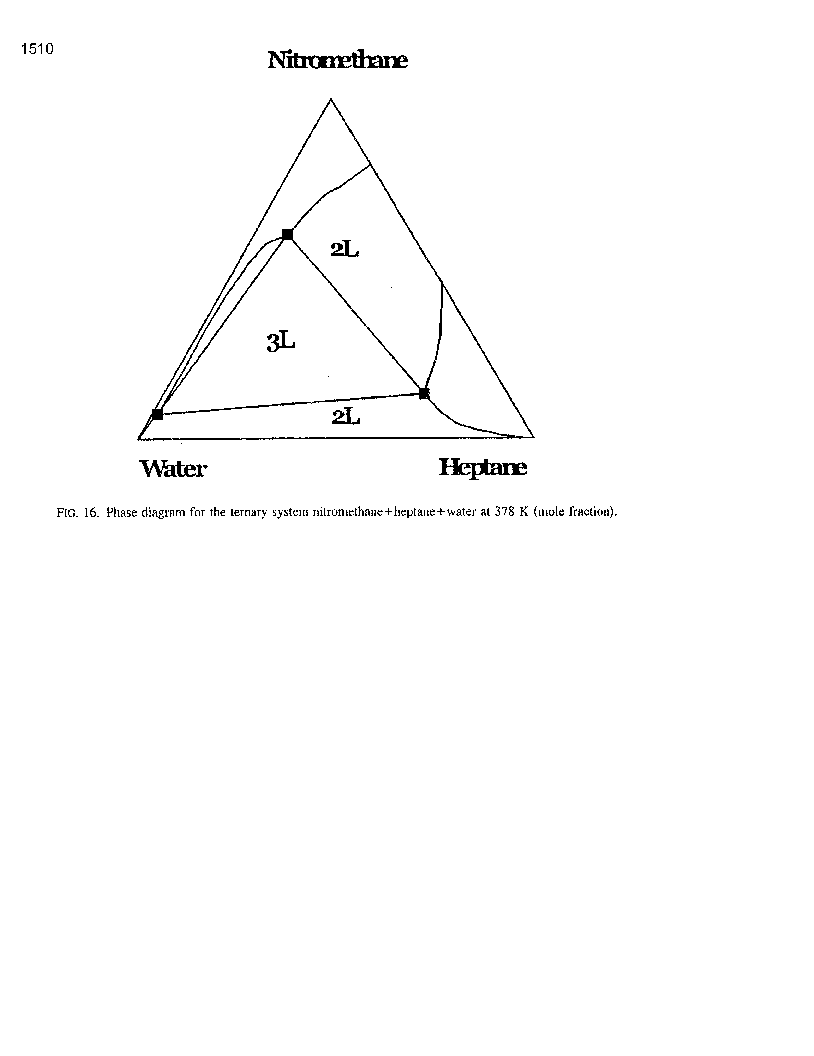
The solubility temperatures of the three and two liquid phases were determined in Zhilyaeva et al.2 by the synthetic method in ternary mixtures with constant mass content of heptane, and also in ternary mixtures with a constant mass content of water. The system nitromethane + heptane + water includes a three-phase region. Depending on temperature the system nitromethane + heptane + water forms a miscibility gaps of Type I to III, Treybal.6 In the temperature range 273 K to 376.5 K, where three binary systems partially miscible, the solubility curves correspond to Type III (Treybal6). A three-phase region occurs below 391.6 K (Zhilyaeva et al.2). Maximal temperature of the three-phase liquid equilibrium was reported to be 391.6 K (Zhilyaeva et al.2) and 395.65 K (Malesinska and Malesinski1). In the temperature range 376.5 K to 381.5 K ( Fig. 16 ) where two binary systems nitromethane + heptane and heptane + water are partially miscible, the solubility curves correspond to Type II (Treybal6). Above 381.5 K this ternary system has only one partially miscible region, Zhilyaeva et al.2 Experimental errors were not reported, but are estimated by the evaluator to be ±0.1 K (temperature) and ±0.002 mass fractions (solubility).

Compositions of three coexisting liquid phases for the ternary system nitromethane + heptane + water were reported at 368 K and 378 K in graphical form (Zhilyaeva et al.2), and also at 298.15 K, 303.15 K, 313.15 K, 323.15 K and 333.15 K (Rezanova et al.3). These data are obtained by interpretation of the graphical cloud-point data in Zhilyaeva et al.2 and presented in Fig. 16, and also by titration method (Rezanova et al.3). The area of the three-phase region decreases with increasing temperature. Experimental errors were reported in Ref. 3 as ±0.02 K (temperature) and ±0.003 mole fractions (composition).
All experimental data are considered tentative.
Figure
Sources:
1
Malesinska, B.; Malesinski, W.; Bull. Acad. Pol. Sci.: Ser. Sci. Chim. 11, 475 (1963).
2
Zhilyaeva, I. N.; Sazonov, V. P.; Sarkisov, A. G.; Khimiya, Nephtekhimiya, Nephtedobycha, Kuibyshev 16 (1971).
3
Rezanova, E. N.; Tojkka, A. M.; Markuzin, N. P.; Vestn. Leningr. Univ.; Fiz.; Khim. 18, 53-6 (1991).
4
Sazonov, V. P.; Marsh, K. N.; Hefter, G. T.; Nitromethane with Water or Organic Solvents: Binary Systems, IUPAC-NIST Solubility Data Series. Vol. 71, J. Phys. Chem. Ref. Data 29 (2000).
5
Shaw, D. G.; 'Hydrocarbons with Water and Seawater, Part I: Hydrocarbons C5 to C7' IUPAC Solubility Data Series, 1989, Vol. 37, Pergamon Press.
6
Treybal, R. E.; Liquid Extraction, McGraw-Hill, New York, 1963.