
Evaluator
Valerii P. Sazonov Department of Physics, Technical UniversityEvaluation
The system nitromethane + propanoic acid + water forms a miscibility gap of Type I, Treybal.3 Only one binary pair of components, nitromethane + water, is partially miscible. The data for this system were previously compiled and critically evaluated (Sazonov et al.4). The recommended values for the solubility of nitromethane in water at 293.2 K is x1" = 0.0345; and at 313.2 K, x1" = 0.0426. The solubility of nitromethane in water at 293.2 K reported in Zhuravlev and Maslovskaya1 (0.090 mass fraction; 0.028 mole fraction) and at 313.2 K in Maslovskaya2 (0.100 mass fraction; 0.032 mole fraction) are rejected because they are inconsistent with recommended values from Sazonov et al.4
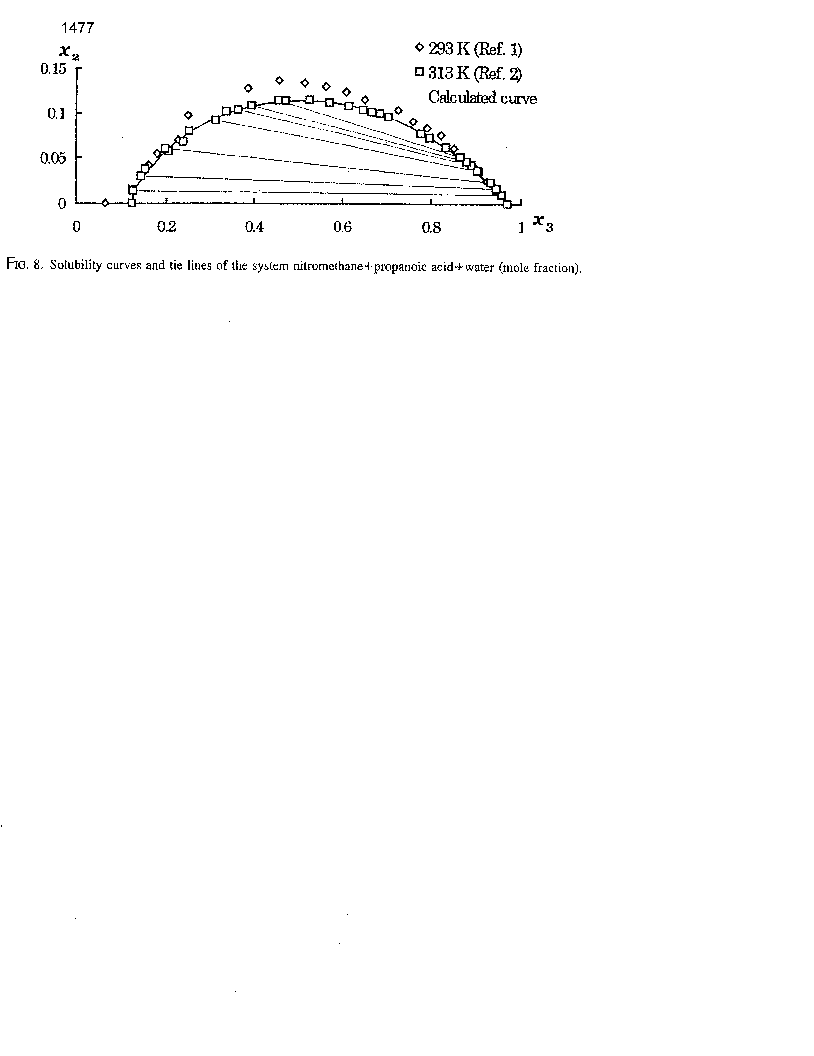
Solubility data obtained by the titration method for the ternary system nitromethane + propanoic acid + water were reported in two references. Data of Zhuravlev and Maslovskaya1 which were reported at 293.2 K are in poor agreement with the data of Maslovskaya,2 which were reported at 313.2 K and are inconsistent with the data at same temperature in a series of systems nitromethane + acid (formic, acetic, butanoic) + water. Therefore data at 293.2 K, Zhuravlev and Maslovskaya,1 were not considered, but in Fig. 8 are given for comparison. Experimental errors were not reported, but are estimated by the evaluator to be ±0.002 mass fractions. Solubility data at 313.2 K (water-rich and nitromethane-rich branches together) are described by an algebraic equation in the form:

This smoothing equation gives a smaller standard deviation than any other tested equation. The equation parameters (a, b, c, d, e) were calculated by the least squares method and presented in Table 2. Binodal curves in this system were calculated and compared separately for solubility data reported in Zhuravlev and Maslovskaya1 and Maslovskaya.2
The solubilities calculated by the proposed equation are presented in Fig. 8. Experimental solubility data, Zhuravlev and Maslovskaya1 and Maslovskaya.2 are presented in Fig. 8 for comparison.
LLE data for the ternary system nitromethane + propanoic acid + water were reported in Maslovskaya.2 Composition of each phase was calculated from the index of refraction-composition curve of saturated mixtures prepared at the time of the saturation curve measurements. The tie lines at 313.2 K cover the whole range of the miscibility gap, Fig. 8. The distribution of acid mainly in the nitromethane-rich phase is observed. Data reported at 293.2 K and at 313.2 K, Maslovskaya,2 are in agreement. Plait points were reported in both cases: at 293.2 K it is x1 = 0.197, x2 = 0.110 and at 313.2 K it is x1 = 0.198, x2 = 0.095. Experimental errors were not reported in the papers, but are estimated by the evaluator to be ±0.005 mass fractions.
Solubility and liquid-liquid equilibrium data measured by different methods are in agreement with one another. Experimental data on solubilities at T/K = 293.2 K and 313.2 K, Zhuravlev and Maslovskaya1 and Maslovskaya,2 are presented in Fig. 8. The ternary solubility data, Maslovskaya,2 were used to obtain equation parameters of the binodal curve.
In view of the inaccurate results obtained in Zhuravlev and Maslovskaya1 and Maslovskaya2 for the binary nitromethane + water system, the evaluator considers the ternary system data to be tentative and concludes that new studies on the ternary system would be of value.
Table 3. Calculated mutual solubilities of nitromethane, propanoic acid and water
| C $T$ ($\pu{K}$) | D w1 | D w2 | D w3 | D $x_{1}$ | D $x_{2}$ | D $x_{3}$ |
|---|---|---|---|---|---|---|
| 313.2 | 1.31 x 10⁻¹ | 0.0 | 8.69 x 10⁻¹ | 4.3 x 10⁻² | 0.0 | 9.57 x 10⁻¹ |
| 313.2 | 1.14 x 10⁻¹ | 4.4 x 10⁻² | 8.42 x 10⁻¹ | 3.8 x 10⁻² | 1.2 x 10⁻² | 9.50 x 10⁻¹ |
| 313.2 | 1.74 x 10⁻¹ | 1.14 x 10⁻¹ | 7.12 x 10⁻¹ | 6.5 x 10⁻² | 3.5 x 10⁻² | 9.00 x 10⁻¹ |
| 313.2 | 2.83 x 10⁻¹ | 1.94 x 10⁻¹ | 5.23 x 10⁻¹ | 1.28 x 10⁻¹ | 7.2 x 10⁻² | 8.00 x 10⁻¹ |
| 313.2 | 3.85 x 10⁻¹ | 2.23 x 10⁻¹ | 3.92 x 10⁻¹ | 2.03 x 10⁻¹ | 9.7 x 10⁻² | 7.00 x 10⁻¹ |
| 313.2 | 4.81 x 10⁻¹ | 2.24 x 10⁻¹ | 2.95 x 10⁻¹ | 2.89 x 10⁻¹ | 1.11 x 10⁻¹ | 6.00 x 10⁻¹ |
| 313.2 | 5.73 x 10⁻¹ | 2.08 x 10⁻¹ | 2.19 x 10⁻¹ | 3.85 x 10⁻¹ | 1.15 x 10⁻¹ | 5.00 x 10⁻¹ |
| 313.2 | 6.62 x 10⁻¹ | 1.78 x 10⁻¹ | 1.60 x 10⁻¹ | 4.92 x 10⁻¹ | 1.08 x 10⁻¹ | 4.00 x 10⁻¹ |
| 313.2 | 7.54 x 10⁻¹ | 1.37 x 10⁻¹ | 1.09 x 10⁻¹ | 6.09 x 10⁻¹ | 9.1 x 10⁻² | 3.00 x 10⁻¹ |
| 313.2 | 8.51 x 10⁻¹ | 8.1 x 10⁻² | 6.8 x 10⁻² | 7.42 x 10⁻¹ | 5.8 x 10⁻² | 2.00 x 10⁻¹ |
| 313.2 | 9.39 x 10⁻¹ | 1.9 x 10⁻² | 4.2 x 10⁻² | 8.56 x 10⁻¹ | 1.4 x 10⁻² | 1.30 x 10⁻¹ |
| 313.2 | 9.65 x 10⁻¹ | 0.0 | 3.5 x 10⁻² | 8.90 x 10⁻¹ | 0.0 | 1.10 x 10⁻¹ |
Figure
Sources:
2
Maslovskaya, N. V.; Dissertation, Kalinin University, 1974.
3
Treybal, R. E.; Liquid Extraction, McGraw-Hill, New York, 1963.
4
Sazonov, V. P.; Marsh, K. N.; Hefter, G. T.; Nitromethane with Water or Organic Solvents: Binary Systems, IUPAC-NIST Solubility Data Series. Vol. 71, J. Phys. Chem. Ref. Data 29 (2000).
1
Zhuravlev, E. F.; Maslovskaya, N. V.; Izv. Vyssh. Uchebn. Zaved.; Khim. Khim. Tekhnol. 18, 334 (1975).