
Evaluator
Walter Hayduk Department of Chemical Engineering, University of OttawaEvaluation
Ethene solubility was reported for elevated pressures in five solvents containing oxygen that are generally described as ketones, an organic carbonate, ester, and an organic acid. When possible, the consistency of the data was tested by plotting log x (mole fraction solubility) versus log p (ethene partial pressure) expecting to observe a linear relation for relatively low concentrations of ethene and for relatively low gas partial pressures. The simplest equation describing the effects of both temperature and pressure has been observed to have the following form:
(1)
For a wider range in temperature, a more accurate description of the temperature effect involving two terms has been sometimes used. Furthermore, when there is a consistent curvature in the log xp - log p relation, a correction to Eq. (1) is introduced, thus describing the data over a larger range of pressure. With these modifications Eq. (1) becomes:(2)
Equation (2) is warranted only when solubility data cover wide ranges of temperature and pressure.The solubility in the individual solvents will now be considered.
2-Propanone (acetone); C3H6O; [67-64-1]
Four research groups reported ethene solubility in 2-propanone1-4: Kiss et al.1 and Shenderei et al.2 for low temperatures, 228.15 K to 248.15 K and a range of pressures, and Voronkov et al.3 and Hronec et al.4 for a wide range of temperatures and pressures. Unfortunately, only the data of the former two groups are self-consistent and consistent with each other. On the other hand, the data of the latter two groups are entirely inconsistent and do not check one another even approximately for comparable temperatures and pressures. To be more specific, the data of Hronec et al.4 do not even approximately approach Henry's law for low pressures, whereas the data for the other three groups of researchers do. The data of Voronkov et al.3 cover a larger pressure range than the other data (to approximately 4 MPa). Unfortunately, the solubility as recorded for Voronkov et al. for the temperatures of 323.15 K, 353.15 K and 373.15 K all are of the same order of magnitude, especially at higher pressures, a most unlikely possibility. Also the data for the lower temperature (263.15 K) does not even approach the higher values of Kiss et al.1 and Shenderei et al.2. It is considered that some serious errors were incorporated in the data of Voronkov et al.3 and those of Hronec et al.4 and, therefore, they are both rejected. Hence, there are no reliable solubility data at elevated pressures for 2-propanone at ambient and higher temperatures. For low temperatures the data of Kiss et al.1 and Shenderei et al.2 are consistent and have been used to develop an equation to represent the data. It should be mentioned that the data of Kiss et al. as obtained for method B gave solubility somewhat lower than those for method A, and hence were considered less accurate and were not used in the development of Eq. (3):
(3)
In this case the combined data of both research groups were reasonably well represented for pressures from 0.1 MPa to 1.0 MPa with an average, and a maximum difference of 2.8%, and 7.0%, respectively. It is noted that a factor for the slight curvature in the log xp - log p lines is included in Eq. (3).These data for solubility in 2-propanone at 228.15 K, 238.15 K, and 248.15 K is classified as tentative.
Propanoic acid (propionic acid); C3H6O3 [79-09-4]
Ethene solubility in propionic acid were reported only as Henry's constant by Efremova and Sokolova5 for the temperatures of 323.15 K, 373.15 K and 423.15 K, although the pressure range for the measurements was reported to be from 2.53 MPa to 12.41 MPa. It is noted that one of the values on the data sheet (for ethene solubility at 423.15 K) is for a temperature above the normal boiling point of the solvent, or above 414 K.
These solubility results are classified as tentative.
Acetic acid, ethenyl ester (vinyl acetate); C4H6O2 [108-5-4]
Only the data of Zernov et al.6 are available for ethene solubility in the ethenyl ester of acetic acid (vinyl acetate) . When the consistency of these data is tested using the relation between log x and log p, three inconsistencies appear. First, at low pressures and for temperatures from 293.1 K to 353.1 K, the solubility is all of the same order of magnitude, which appears to be a most unlikely behavior. Next, at pressures greater than 1 MPa for some of the data the solubility form large irregular inflections in the solubility-pressure relation; again this appears most unlikely. Finally, the composition of the gas phase at equilibrium indicates a relatively constant vapor content of the gas phase with changing pressures over large pressure ranges. This also, appears unlikely.
Only because no other solubility results are available in this solvent for comparison, these solubility data are classified as tentative.
1,3-Dioxolan-2-one, 4-methyl-(propylene carbonate); C4H6O3; [108-32-7]
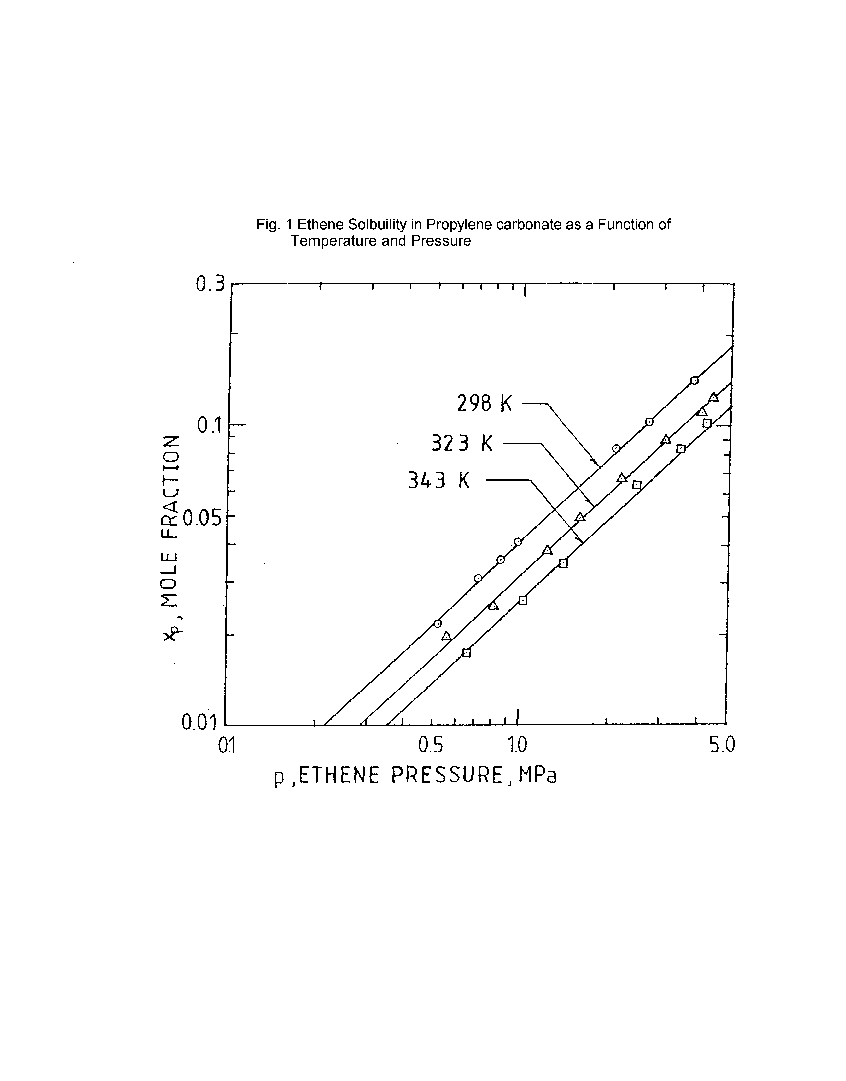
Ethene solubility in 1,3-dioxolan-2-one, 4-methyl (propylene carbonate) as reported by Shakhova et al.7 is entirely consistent. An equation based on all the data for the complete pressure range was developed as follows:
(4)
Vapor pressures for this solvent are not readily available but believed to be low. In the development of Eq. (4) it was assumed that the solvent vapor pressure was negligible. The average, and maximum, deviations for the data from the equation are 2.3%, and 6.4%, respectively. When extrapolated to 0.1013 MPa for a temperature of 298.15 K, a value of the ethene solubility of 0.00495 mole fraction ethene, is obtained.Figure 1 shows these data for propylene carbonate solvent and the lines representing Eq. (4). These data are classified as tentative:

2-Butanone (methyl ethyl ketone); C4H8O; [74-93-3]
Ethene solubility in 2-butanone for varying pressures at 223.15 K 238.15 K and 248.15 K as reported by Shenderei et al. (2) are entirely consistent when plotted as log x versus log p. An equation based on the data for mole fraction solubility (xp) of less than 0.60 is as follows:
(5)
The vapor pressure for 2-butanone at these low temperatures was considered to be negligibly low. The average, and maximum deviations of the data from Eq. (5) are 2.8%, and 8.8%, respectively. There are no low pressure solubility data for this solvent for comparison.These data are classified as tentative.
Figure
Sources:
1
Kiss, G.; Vanko, M.; Hagara, A.; Vanko, A.; Petrochemia (Czechoslovakia), 1980, 20, 132-137.
2
Shenderei, E. R.; Zel'venskii, Ya. D.; Ivanovskii, F. P.; Russian J. Phys. Chem. 1962, 36, 415-419.
3
Voronkov, A. P.; Mislavskaya, V. S.; Mushii, R. Ya.; Drygina, V. V.; Zh. Prikl. Khim. 1979, 52, 2642.
4
Hronec, M.; Hagara, A.; Ilavsky, J.; Petrochemia, (Czechoslovakia), 1983, 23, 111-115.
5
Efremova, G. D.; Sokolova, E. S.; Zh. Fiz. Khim. 1973, 47, 1228-9.
6
Zernov, V. S.; Kogan, V. B.; Lyubetskii, S. G.; J. Appl. Chem. USSR 1971, 44, 1837-40.
7
Shakhova, S. F.; Zubchenko, Yu. P.; Rezina, O. A.; Khim. Prom. 1973, 49, 271-2.