
Evaluator
Glenn T. Hefter School of Mathematical and Physical Sciences, Murdoch UniversityEvaluation
The original data in all these publications are compiled in the Data Sheets immediately following this Critical Evaluation. In addition critical phenomena have been investigated by Roof (ref 8). These are considered along with solubility data at high pressures in Section 3 below.
For convenience further discussion of this system will be in three parts.
1. THE SOLUBILITY OF OCTANE (1) IN WATER (2)
Agreement amongst the independent determinations of the solubility of octane in water is not particularly good and no data have been Recommended.
At 298K the value reported by Price (ref 11) is substantially lower than all other studies (ref 5,9,10,15) and has been rejected. At higher temperatures the values of Price (ref 12) are also considerably lower than those of Heidman et al. (ref 16). In the absence of confirmatory studies, it is not reasonable to reject Price's data outright but they have not been used in the calculation of 'Best' values. Application of the van't Hoff equation to both data sets gives values of ΔHs1n = -3.3 (ref 12) and +13.3 (ref 16) kJ mo1-1 and ΔCp,s1n = 568 (ref 12) and 284 (ref 16) J K -1 mo1-1. Neither set of values are close to those reported for related systems although those of Heidman et al. are somewhat more reasonable.
At other temperatures the data of Fuhner (ref 1), Nelson and De Ligny (ref 6), and Budantseva et al. (ref 11) are markedly higher than all other studies and are therefore rejected. All the remaining data are summarized in Table 2 and selected data are plotted in Figure 1.

It is interesting to note that the averaged 'Best' value at 298K is very close to the value which would be predicted by an extrapolation of the lower n-alkane solubilities.
2. THE SOLUBILITY OF WATER (2) IN OCTANE (1)
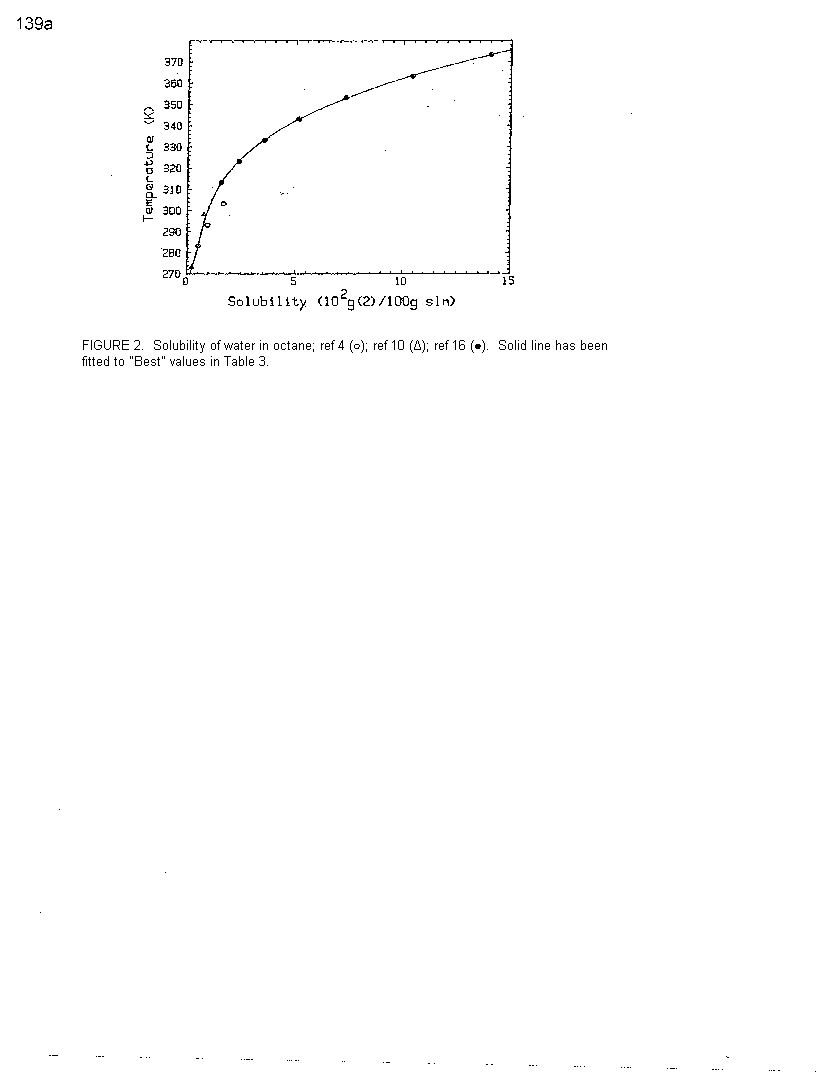
Only limited data are available for the solubility of water in n-octane and agreement amongst independent determinations is only fair. The datum of Black et al. (ref 2) is much higher than all other values and is therefore rejected. The remaining data are collected in Table 3 and plotted in Figure 2.

3. SOLUBILTY STUDIES OF THE OCTANE (1) - WATER (2) SYSTEM AT ELEVATED PRESSURES
This system exhibits phase behavior which is topographically similar to that of benzene + water, i.e., it belongs to type III phase behavior using Scott and von Konynenburg's (ref 17) classification (see Figure 3 and then Introduction to this volume).

Quantitative solubility data on the octane -water system at elevated pressures have been reported in the studies listed in Table 4.
As can be seen from Table 4 data have not generally been obtained under comparable conditions, making Critical Evaluation difficult. However, it may be noted that the solubility of 9.95 g(2)/100g s1n of water in octane at 7.4 MPa and 538.2 K reported by Skripka (ref 14) differs markedly from the value of 14.9 g(2)/100g s1n reported at 7.41 MPa and 539.1 K by Heidman et al. (ref 16). Further studies are necessary before any preference can be expressed for either data set. Previous mention (Section 1 above) has already been made of the fact that the solubilities of octane in water reported by Heidman et al. (ref 16) are much higher than those of Price (ref 12).
On the other hand the properties of the critical end point (Figure 3) reported by Roof: 7.41 MPa and 540.4 K, are in good agreement with those reported by Heidman et al. (ref 16): 7.41 MPa and 539.1 K.
Figures


Sources:
3
Baker, E. G.; Geochim. Cosmochim. Acta 1960, 19, 309-317.
1
Fühner, H.; Ber. Dtsch. Chem. Ges. 1924, 57, 510-15.
2
Black, C.; Joris, G. G.; Taylor, H. S.; J. Chem. Phys. 1948, 16, 537-43.
4
Englin, B. A.; Plate, A. F.; Tugolukov, V. M. Pryanishnikova, M. A.; Chem. Technol. Fuels Oils, 1965, 1(9), 722-726.
5
McAuliffe, C.; J. Phys. Chem. 1966, 70, 1267-1275.
6
Nelson, H. D.; De Ligny, C. L.; Recl. Trav. Chim. Pays-Bas 1968, 87, 528-44.
7
Alwani, Z.; Schneider, G. M.; Ber. Bunsenges. Phys. Chem. 1969, 73, 294-301.
8
Roof, J. G.; J. Chem. Eng. Data 1970, 15, 301-3.
9
Krasnoschchekova, R. Ya.; Gubergrits, M. Ya.; Neftekhimiya 1973, 13, 885-8.
10
Polak, J.; Lu, B. C. Y.; Can. J. Chem. 1973, 51, 4018-23.
11
Budantseva, L. S.; Lesteva, T. M.; Nemstov, M. S.; Zh. Fiz. Khim. 1976, 50, 1344.
12
Price, L. C.; Am. Assoc. Petrol. Geol. Bull. 1976, 60, 213-44.
13
Krzyzanowska, T.; Szeliga, J.; Nafta (Katowice) 1978, 12, 413-7.
14
Skripka, V. G.; Tr. Vses. Neftegazov. Nauch. Issled. Inst. 1976, 61, 139-51.
15
Jonsson, J. A.; Vejrosta, J.; Novak, J.; Fluid Phase Equilib. 1982, 9, 279-86.
16
Heidman, J. L.; Tsonopoulos, C.; Brady, C. J.; Wilson, G. M.; A. I. Ch. E. J. 1985, 31, 376-84.
17
van Konynenburg, P. H.; Scott, R. L.; Phil. Trans. Roy. Soc. A
1980, 298, 495.