
Evaluator
Glenn T. Hefter School of Mathematical and Physical Sciences, Murdoch UniversityEvaluation
The original data in all of the publications listed in Table 1 are compiled in the Data Sheets immediately following this Critical Evaluation.
As indicated in the footnotes to Table 1, quantitative solubility data for toluene in heavy water (ref 15) and D2O in toluene (ref 28), have been reported. However, since no other comparable data are available, no critical evaluation of the reliability of these data can be made. The interested user is referred to the relevant Data Sheets for experimental solubilities. Solubility values reported by Price (ref 30) were not available for inspection. Solubility data may also be calculated from the calorimetric data of Gill et al. (ref 38).
Critical point data have been reported by Alwani and Schneider (ref 25) and Roof (ref 27) and are discussed in section 3 below.
In the toluene-water system the mutual solubilities are sufficiently low to enable data reported in w/v fractions (or equivalent) to be converted to mass percent solubilities with reasonable precision by assuming solution densities to be the same as the pure solvents. These conversions are given in the Data Sheets and the data are included in this Evaluation. The data of Jaeger (ref 1), Booth and Everson (ref 8), Wing and Johnston (ref 13), Jones and Monk (ref 7) and Sada et al. (ref 36) given in v/v fractions have not been converted and so have been excluded from this Evaluation.
In the Tables which follow, values obtained by the Evaluator by graphical interpolation or extrapolation of the original measurements given in the Data Sheets are indicated by an asterisk (*). 'Best' values have been obtained by simple averaging. The uncertainty limits (σn) attached to these values do not have statistical significance and should be regarded only as a convenient representation of the spread of values rather than as error limits. The letter (R) indicates 'Recommended' data. Data are 'Recommended' if two or more apparently reliable studies are in reasonable agreement (±5% relative). All other data are regarded as 'Tentative'. For convenience, further discussion of this system will be divided into three parts.
1. THE SOLUBILITY OF TOLUENE (1) IN WATER (2)
The solubility of toluene in water has been investigated on numerous occasions (Table 1)
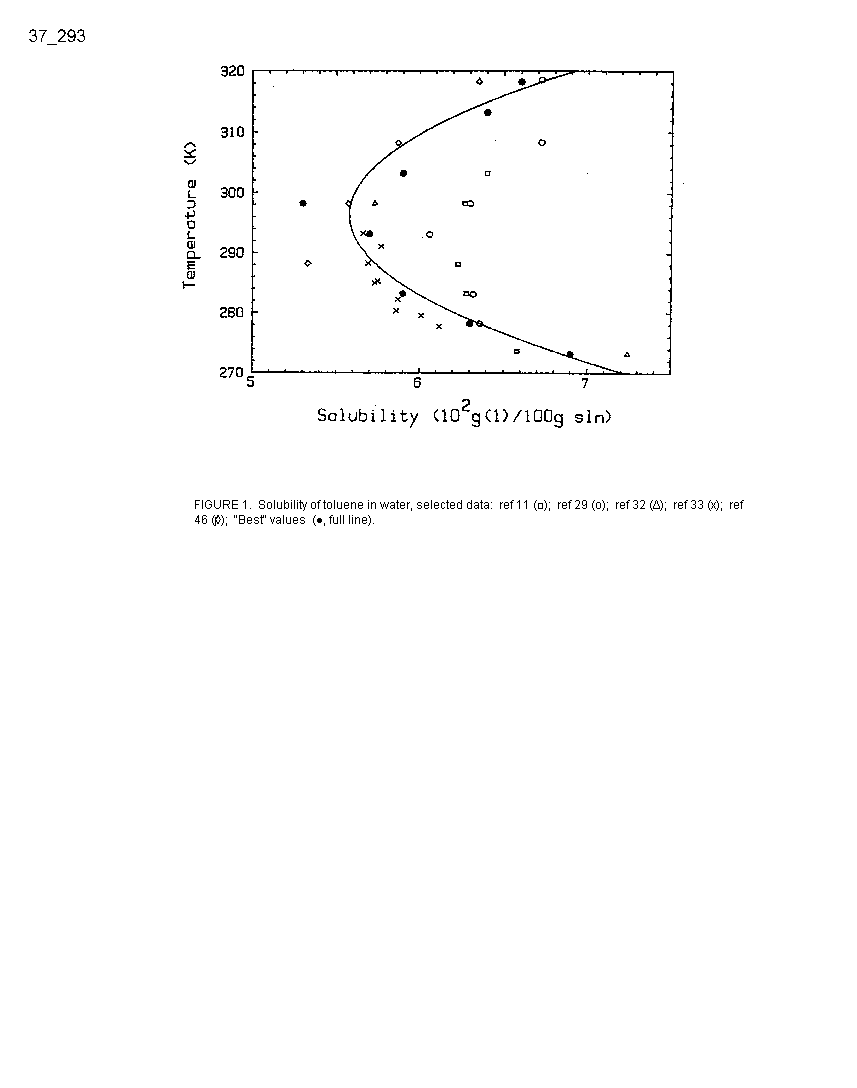
The large amount of data at 298 K enables a particularly critical assessment of the reported values. Data have been rejected if they deviated significantly (> 3 σn) from the average value. Thus, at 298 K the value of Krasnoshchekova and Gubergrits (ref 34), which is markedly lower than all other values, and Bohon and Claussen (ref 11), Pierotti and Liabastre (ref 29), Korenman and Aref'eva (ref 41), Banaerjee et al. (ref 43) and Schwarz (ref 44, 297 K), which are higher, have all been rejected. The datum of Krzyzanowska and Szeliga (ref 42) has not been included in the Critical Evaluation because it does not appear to be independent of that of Price (ref 38).
At temperatures other than 298 K, the data of Fühner (ref 2) and Uspenskii (ref 3) are markedly lower than all other values and are rejected. All other data are included in Table 2 except for the high temperature data which are discussed in section 3 below.
Agreement among the studies (ref 11, 29, 33, 46, 47) which report solubilities over a range of temperatures below 323 K is disappointing (see Table 2 and Figure 1). For example, although the solubility data of Pierotti and Liabastre (ref 29) are usually markedly higher than Recommended values in well-characterized systems (e.g. benzene in water) their toluene results lie within the range of values reported by other workers. Even the averaged 'Best' solubilities, which usually show a smoother variation with temperature than individual data sets, show a good deal of scatter (e.g. compare Figure 1 with the analogous diagram for benzene and water).

Thermodynamic data calculated by application of the van't Hoff equation to the variable temperature solubility studies are summarized in Table 3. As might be expected from the scatter in the reported solubilities none of the derived thermodynamic functions agree closely with reliable calorimetric values (Table 3). Even the averaged 'Best' solubilities which should show minimal systematic (temperature dependent) errors give a disappointing value for ΔCp,s1n.
2. THE SOLUBILITY OF WATER (2) IN TOLUENE (1)
A reasonable amount of data is available for the solubility of water in toluene over the temperature range 273-323K.
In spite of the difficulties of accurate analysis at the relatively low concentrations involved, the results are generally in good agreement and a number of 'Best' values have been 'Recommended' (Table 4).
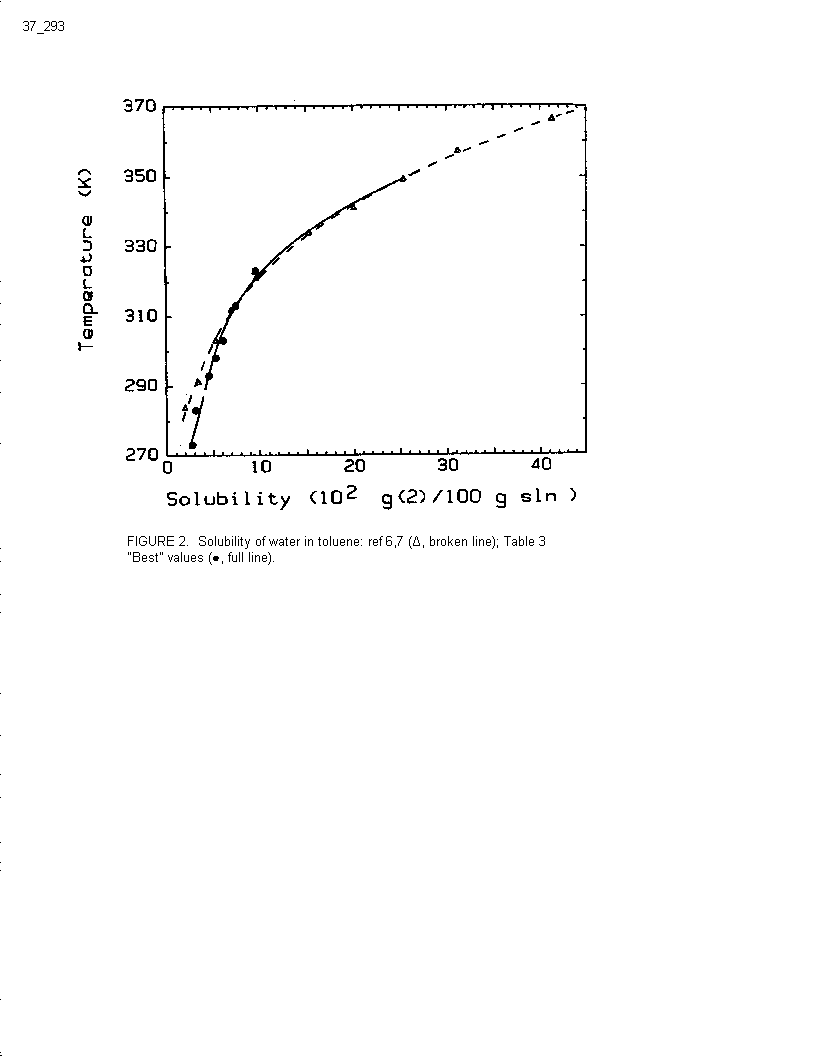
Except for the low temperature (T < 313K) values of Tarassenkow and Poloshinzewa (ref 6,7) and the datum of Benkovski et al. (ref 26), which are markedly lower than all other values and are therefore rejected, all the available data are listed in Table 4. Selected data are also plotted in Figure 2 .

Despite the relatively small differences between the data of Tarassenkow and Poloshinzewa (ref 6,7) and the 'Best" values of Table 4 (see Figure 2), application of the van't Hoff equation yields quite different values of ΔHs1n (31 and 21 kJ mo1-1) and ΔCp,s1n (-24 and +239 J K-1 mo1-1 respectively). Comparison with similar reactions (e.g. water in benzene: ΔHs1n=24 kJ mo1-1 and ΔCp,s1n=99 JK-1 mo1-1 suggests the 'Best' values may be more reliable.
3. MUTUAL SOLUBILITIES OF TOLUENE (1) AND WATER (2) AT ELEVATED PRESSURES
Solubilities in the toluene + water system have been studied at higher than atmospheric pressure in a few publications but the system lacks a comprehensive study. Table 5 gives the range of conditions under which the system has been studied.
As can be seen there is little overlap between the various workers and a meaningful comparison cannot be made. The interested user is referred to the relevant Data Sheets for experimental solubilities. However, it should be noted that thermodynamic functions calculated from the data of Guseva and Parnov (ref 15,16) disagree markedly with other values and are unlikely to be correct.
The phase behavior of this system is similar to that of benzene + water. Here are two critical loci, one starting at the critical point of water and eventually approaching high pressure. The second starts at the critical point of toluene and ends in a critical end point on a three phase line. The topology of the pressure-temperature projection is similar to that given for benzene + water except that the temperature at which the vapor pressures of the two pure components are equal is considerably lower than in the benzene + water system.
In the region above the three phase line on the pressure- temperature projection, the pressure is greater than the vapor pressure and then a maximum of tow liquid phases is possible. There may be one or two liquid phases depending on the overall composition. To the left of the critical line starting at toluene it is possible to have one or two phases present depending on the overall composition.
Roof (ref 27) has determined the temperature and pressure of the critical end point in this system to be T = 558.1K, P = 10.10 MPa.
Figures
Sources:
26
Benkovski, V. G.; Nauruzov, M. H.; Bogoslovaskaya, T. M.; Tr. Inst. Khim. Nefti Prir. Solei Akad. Nauk Kaz. SSR 1970, 2, 25-32.
1
Jaeger, A.; Brennst. Chem. 1923, 4, 259.
2
Fühner, H.; Ber. Dtsch. Chem. Ges. 1924, 57, 510-15.
3
Uspenskii, S. P.; Neft. Khoz. 1929, 11-12, 713-7.
4
Rosenbaum, C. K.; Walton, J. H.; J. Am. Chem. Soc. 1930, 52, 3568-73.
5
Gross, P. M.; Saylor, J. H.; J. Am. Chem. Soc. 1931, 53, 1744-51.
6
Tarasenkov, D. N.; Polozhebtseva, E. N.; Zh. Obshch. Khim. 1931, 1, 71-9.
7
Tarassenkow, D. N.; Poloshinzewa, E. N.; Ber. Dtsch. Chem. Ges. 1932, 65B, 184-6.
8
Booth, H. S.; Everson, H. E.; Ind. Eng. Chem. 1948, 40, 1491-3.
9
Andrews, L. J.; Keefer, R. M.; J. Am. Chem. Soc. 1949, 71, 3644-77.
10
Klevens, H. B.; J. Phys. Chem. 1950, 54, 283-98.
11
Bohon, R. L.; Claussen, W. F.; J. Am. Chem. Soc. 1951, 73, 1571-8.
12
Morrison, T. J.; Billett, F.; J. Chem. Soc. 1952, 3819-3822.
13
Wing, J.; Johnston, W. H.; J. Am. Chem. Soc. 1957, 79(4), 864-5.
14
Caddock, B. D.; Davies, P. L.; J. Inst. Petrol. 1960, 46, 391-6.
15
Guseva, A. N.; Parnov, E. I.; Radiokhimiya 1963, 5, 507-9.
16
Guseva, A. N.; Parnov, E. I.; Vestn. Mosk. Univ. Khim. 1963, 18, 76-9.
17
Jones, J. R.; Monk, C. B.; J. Chem. Soc. 1963, 2633-5.
18
McAuliffe, C.; Nature 1963, 200, 1092-3.
19
Hogfeldt, E.; Bolander, B.; Ark. Kemi 1963, 21(16), 161-86.
20
Englin, B. A.; Plate, A. F.; Tugolukov, V. M. Pryanishnikova, M. A.; Chem. Technol. Fuels Oils, 1965, 1(9), 722-726.
21
Connolly, J. F.; J. Chem. Eng. Data 1966, 11, 13-6.
22
Johnson, J. R.; Christian, S. D.; Affsprung, H. E.; J. Chem. Soc. A. 1966, 77-8.
23
McAuliffe, C.; J. Phys. Chem. 1966, 70, 1267-1275.
24
Gregory, M. D.; Christian, S. D.; Affsprung, H. E.; J. Phys. Chem. 1967, 71, 2283-9.
25
Alwani, Z.; Schneider, G. M.; Ber. Bunsenges. Phys. Chem. 1969, 73, 294-301.
27
Roof, J. G.; J. Chem. Eng. Data 1970, 15, 301-3.
28
Glasoe, P. K.; Schultz, S. D.; J. Chem. Eng. Data 1972, 17, 66-8.
29
Pierotti, R. A.; Liabastre, A. A.; "Structure and properties of water solutions. " U. S. Nat. Tech. Inform. Serv.; PB Rep.; 1972, No. 21163, 113 p.
30
Price, L. C.; Ph.D. Dissertation, University of California, Riverside, CA, 1973.
31
Bradley, R. S.; Dew, M. J.; Munro, D. C.; High Temp. High Press. 1973, 5, 169-76.
32
Polak, J.; Lu, B. C. Y.; Can. J. Chem. 1973, 51, 4018-23.
33
Brown, R. L.; Wasik, S. P.; J. Res. Natl. Bur. Stan. 1974, 78A, 453-60.
34
Krasnoschchekova, R. Ya.; Gubergrits, M. Ya.; Vodnye. Resursy. 1975, 2, 170-3.
35
Mackay, D.; Shiu, W. Y.; Can. J. Chem. Eng. 1975, 53, 239-42.
36
Sada, E.; Kito, S.; Ito, Y.; J. Chem. Eng. Data 1975, 20, 373-5.
37
Sutton, C.; Calder, J. A.; J. Chem. Eng. Data 1975, 20, 320-2.
38
Gill, S. J.; Nichols, N. F.; Wadso, I. J.; Chem. Thermodyn. 1976, 8, 445-52.
39
Price, L. C.; Am. Assoc. Petrol. Geol. Bull. 1976, 60, 213-44.
40
Korenman, I. M.; Aref'eva, R. P.; Patent USSR, 553 524, 1977.
41
Korenman, I. M.; Aref'eva, R. P.; Zh. Prikl. Khim. 1978, 51, 957-8.
42
Krzyzanowska, T.; Szeliga, J.; Nafta (Katowice) 1978, 12, 413-7.
43
Banerjee, S.; Yalkowsky, S. H.; Valvani, S. C.; Environ. Sci. Technol. 1980, 14, 1227-9.
44
Schwarz, F. P.; Anal. Chem. 1980, 52, 10-15.
45
Rossi, S. S.; Thomas, W. H.; Environ. Sci. Technol. 1981, 15, 715-6.
46
Sanemasa, I.; Araki, M.; Deguchi, T.; Nagai, H.; Chem. Lett. 1981, 225-8.
47
Sanemasa, I.; Araki, M.; Deguchi, T.; Nagai, H.; Bull. Chem. Soc. Jpn. 1982, 55, 1054-62.
48
Sanemasa, I.; Arakawa, S.; Araki, M.; Deguchi, T.; Bull. Chem. Soc. Jpn. 1984, 57, 1539-44.