
Evaluator
Glenn T. Hefter School of Mathematical and Physical Sciences, Murdoch UniversityEvaluation
Apart from the following exceptions, original data in all the references listed in Table 1 are compiled in the Data Sheets immediately following this Critical Evaluation. The work of Herz (ref 1) and Milligan (ref 4) has not been compiled because they employed petroleum fractions of unspecified composition rather than pure hexane. The work of Scheffer and Roof (ref 2, 42; critical point data only), Bennet and Philip (ref 5; order of magnitude solubility only) and Gester (ref 7; graphical data only) did not contain sufficient information to justify compilation. Solubility data for hexane in water may also be obtained from the calorimetric data of Gill et al. (ref 37).
Despite the relatively large number of studies of the hexane-water system (Table 1) little information is available on the temperature dependence of the mutual solubilities of hexane and water. Even when comparable data are available, independently obtained values often differ by an order of magnitude. This system warrants thorough re-investigation at all temperatures.
In the Tables which follow, values obtained by the Evaluator by graphical interpolation of the original measurements contained in the Data Sheets are indicated by and asterisk (*). 'Best' values have been obtained by simple averaging. Uncertainty limits (σn) attached to these values do not have Statistical significance and should be regarded only as a convenient representation of the spread of reported values rather than as error limits.
For convenience, further discussion of this system will be divided into three parts.
1. THE SOLUBILITY OF HEXANE (1) IN WATER (2)
The various data reported for the solubility of hexane in water are in poor agreement.
The value of Mackay et al. (ref 26) is rejected because the temperature was not specified. The data of Krzyzanowska and Szeliga (ref 35) have been excluded from consideration as they do not appear to be independent of those of Price (ref 29).
Of the remaining data, the results of Fühner (ref 3), Booth and Everson (ref 6, order of magnitude), Durand (ref 9), McBain and Lissant (ref 10), Kudchadker and McKetta (ref 13, atmospheric pressure data only), McCants et al. (ref 11,12) Barone et al. (ref 16), Nelson and De Ligny (ref 19) and Korenman and Aref'eva (ref 31,34) are markedly higher, sometimes by an order of magnitude, than other results and are therefore rejected. All other data are included in Table 2 on the next page.
At 298 K, the temperature where there is a reasonable number of independent determinations (Table 2), the various values are in reasonable agreement although the uncertainty on the average result means that it can be considered as 'Tentative' only. This is almost certainly a reflection of the difficulties of accurate analysis of the very low concentrations involved even when using modern techniques (it is interesting to note that all the data at 298 K were obtained by GLC methods).
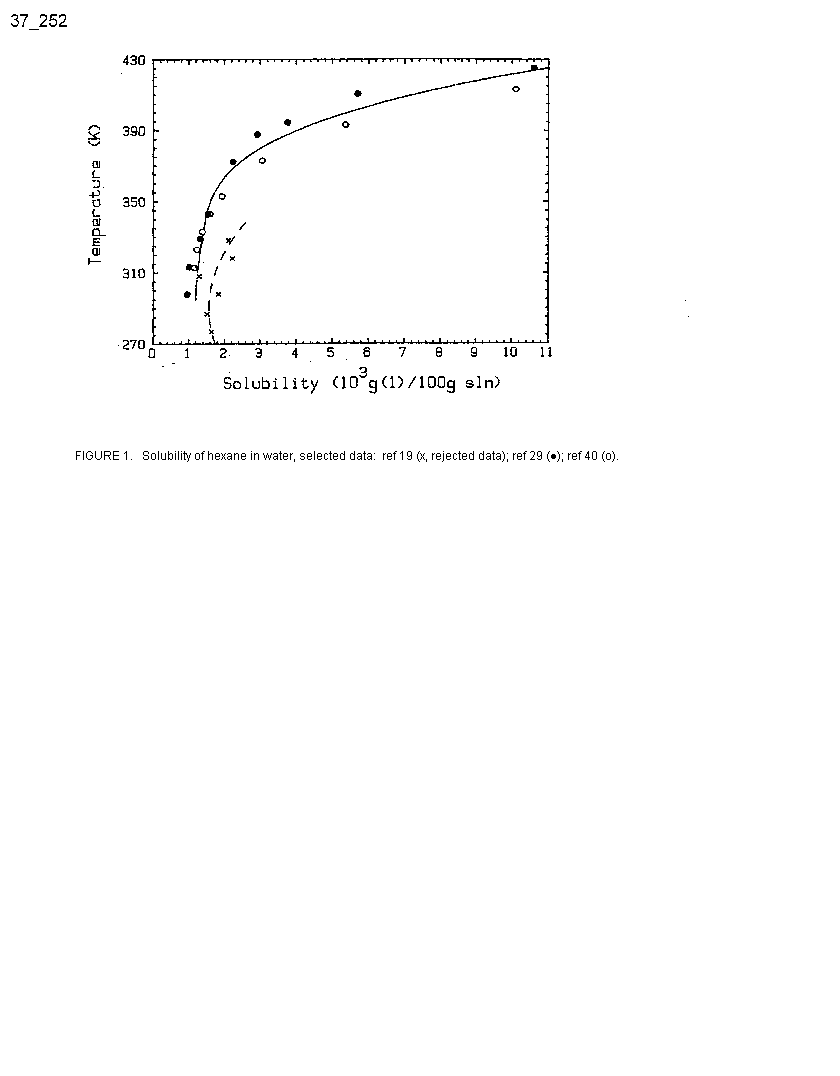
At other temperatures, the results of Price (ref 29) and Tsonopoulos and Wilson (ref 40) are in quite good agreement up to 353 K but begin to diverge at higher temperatures (Table 2 and Figure 1). Application of the van't Hoff equation to a combination of both data sets (ref 29,40) yields values for ΔH∞s1n = 1.87 kJ mo1-1, ΔC∞p,s1n = 296 JK-1 mo1-1 which are in relatively poor agreement with the calorimetric values of ΔH∞s1n = 0.0 ±0.2 kJ mo1-1 and Δ∞Cp,s1n = 440 ±45 JK -1 mo1-1 reported by Gill et al. (ref 37). In view of the disparities at higher temperatures, the uncertainty in the 298 K value and the poor agreement with calorimetric data, none of averaged 'Best' values have been Recommended.

Figure 1 plots a selection of the solubility data of hexane in water. Aswell as the values of Price (ref 29) and Tsonopoulos and Wilson (ref 40), referred to above, the rejected data of Nelson and De Ligny (ref 19) have also been included for comparison.
2. THE SOLUBILITY OF WATER (2) IN HEXANE (1)
Solubility data for water in hexane are listed in Table 3, apart from the values of McCants et al. (ref 11,12), which are an order of magnitude higher than all other studies and have therefore been rejected.
In general, agreement amongst independently obtained values is poor (Table 3). This is probably a reflection of the difficulties of accurate analysis at these low concentrations. No data have been Recommended.
Figure 2 plots all the available data for the solubility of water in hexane. The smooth curve which has been fitted to the 'Best' values (Table 3) has the form s(102g(1)/100g sln) = 86.5345 - 0.6183 T + 0.00113 T2 with R2 = 0.977 and σ = 0.446, 293 ≤ T ≤ 353 K.

Application of the van't Hoff equation to the 'Best' values gives ΔH∞sln = 28.7 kJ mo1-1 and ΔC∞p,s1n = 73 JK-1 mo1-1 for the dissolution of water in hexane. These values are broadly similar to those reported for other hydrocarbons and suggests, despite the lack of agreement amongst the individual studies in Table 3, that the Tentative 'Best' values are reasonably reliable.
3. MUTUAL SOLUBILITIES OF HEXANE (1) AND WATER (2) AT ELEVATED PRESSURES
This system exhibits the phenomenon of gas-gas immiscibility of the second kind and has type III phase behavior (ref 43,44). In order to clarify the relationship between the phases in equilibrium it is convenient to consider the pressure-temperature projection of the pressure-temperature-composition diagram. A schematic representation of this projection for water + hexane is given in Figure 3. There are two critical lines, one starting at the critical point of hexane and ending on a three phase line. It should be noted that the three phase line on a pressure-temperature projection corresponds to three lines on the pressure-temperature-composition diagram, representing the composition of gas, liquid 1 and liquid 2 in equilibrium. The second critical line starts at the critical point of water, moves to lower temperatures at high pressures, passes through a minimum in temperature and eventually goes to temperatures greater than that of the critical point of water (this behavior is referred to as gas-gas immiscibility of the second kind).

In the region above the three phase line on the p, T projection there is no vapor phase but may be a maximum of two liquid phases. Whether there is (are) one or two liquid phases depends on the overall composition. To the left of the critical line starting at the critical point of water it may be possible to have one or two phases present depending on the overall composition.
Solubility studies of the hexane-water system at pressures higher than atmospheric are listed in Table 4.
As can be seen from Table 4, virtually none of the solubility data at elevated pressures have been obtained under comparable conditions, thus precluding evaluation of their reliability. However, it should be noted that the atmospheric pressure data of Kudchadker and McKetta (ref 13) disagree markedly from other studies. Also, the interpolated values of Burd and Braun (ref 18) and Skripka et al. (ref 28) at ~ 473K and ~3.2 MPa are in poor agreement (~3.2 and ~ 1.8 g(2)/100g s1n respectively).
Roof and Scheffer have measured the temperature and pressure at the critical end point. Their values are in reasonable agreement (Table 4).
De Loos et al. (ref 39) have studied the two phase -one phase boundaries near but to the left of the critical line starting at the critical point of water (refer to Figure 3). Although the absence of confirmatory studies precludes Critical Evaluation the results are consistent with the phase behavior of other alkane + water systems.
The interested user is referred to the original measurements in the data sheets for further information, bearing in mind that all values should be regarded as very tentative.
Figures


Sources:
19
Nelson, H. D.; De Ligny, C. L.; Recl. Trav. Chim. Pays-Bas 1968, 87, 528-44.
2
Scheffer, F. E. C.; Proc. Roy. Acad. Amsterdam 1913, 16, 404-18.
3
Fühner, H.; Ber. Dtsch. Chem. Ges. 1924, 57, 510-15.
1
Herz, W.; Ber. Dtsch. Chem. Ges. 1898, 31, 2669-72.
4
Milligan, L. H.; J. Phys. Chem. 1924, 28, 494-7.
5
Bennett, G. M.; Philip, W. G.; J. Chem. Soc. 1928, 1937-42.
6
Booth, H. S.; Everson, H. E.; Ind. Eng. Chem. 1948, 40, 1491-3.
7
Gester Jr., G. C.; Chem. Eng. Progr. 1947, 43, 117-32.
8
Black, C.; Joris, G. G.; Taylor, H. S.; J. Chem. Phys. 1948, 16, 537-43.
9
Durand, R.; C. R. Hebd. Seances Acad. Sci. 1948, 226, 409-10.
10
McBain, J. W.; Lissant, K. J.; J. Phys. Colloid. Chem. 1951, 55, 655-62.
11
McCants, J. F.; Jones, J. H.; Hopson, W. H.; Ind. Eng. Chem. 1953, 45, 454-6.
12
Jones, J. H.; McCants, J. F.; Ind. Eng. Chem. 1954, 46, 1956-8.
13
Kudchadker, A. P.; McKetta, J. J.; Petrol Refiner 1961, 40, 231-2.
14
Englin, B. A.; Plate, A. F.; Tugolukov, V. M. Pryanishnikova, M. A.; Chem. Technol. Fuels Oils, 1965, 1(9), 722-726.
15
Zel'venskii, Ya. D.; Efremov, A. A.; Larin, G. M.; Chem. Technol. Fuels Oils 1965, 1(7) 506.
16
Barone, G.; Crescenzi, V.; Pispisa, B.; Quadrifoglio, F.; J. Macromol. Chem. 1966, 1, 761-71.
17
McAuliffe, C.; J. Phys. Chem. 1966, 70, 1267-1275.
18
Burd Jr., S. D.; Braun, W. G.; Proc. Div. Refining.; Am. Petrol. Inst. 1968, 48, 464-76.
20
Roddy, J. W.; Coleman, C. F.; Talanta 1968, 15, 1281-6.
21
Benkovski, V. G.; Nauruzov, M. H.; Bogoslovaskaya, T. M.; Tr. Inst. Khim. Nefti Prir. Solei Akad. Nauk Kaz. SSR 1970, 2, 25-32.
22
Krasnoschchekova, R. Ya.; Gubergrits, M. Ya.; Neftekhimiya 1973, 13, 885-8.
23
Sultanov, R. G.; Skripka, V. G.; Zh. Fiz. Khim. 1973, 47, 1035.
24
Leinonen, P. J.; Mackay, D.; Can. J. Chem. Eng. 1973, 51, 230-3.
25
Polak, J.; Lu, B. C. Y.; Can. J. Chem. 1973, 51, 4018-23.
26
Mackay, D.; Shiu, W. Y.; Wolkoff, A. W.; "Water Quality Parameters" Symp. 1973, ASTM Spec. Tech. Publ. 1975, 573, 251-8.
27
Budantseva, L. S.; Lesteva, T. M.; Nemstov, M. S.; Zh. Fiz. Khim. 1976, 50, 1344.
28
Namiot, A. Yu.; Skripka, V. G.; Lotter, Yu. G.; Zh. Fiz. Khim. 1976, 50, 2718.
29
Price, L. C.; Am. Assoc. Petrol. Geol. Bull. 1976, 60, 213-44.
30
Skripka, V. G.; Tr. Vses. Neftegazov. Nauch. Issled. Inst. 1976, 61, 139-51.
31
Korenman, I. M.; Aref'eva, R. P.; Patent USSR, 553 524, 1977.
32
Sugi, H.; Katayama, T.; J. Chem. Eng. Jpn. 1977, 10, 400-2.
33
Charykov, A. K.; Tikhomirov, V. I.; Potapova, T. M.; Zh. Obshch. Khim. 1978, 48, 1916-21.
34
Korenman, I. M.; Aref'eva, R. P.; Zh. Prikl. Khim. 1978, 51, 957-8.
35
Krzyzanowska, T.; Szeliga, J.; Nafta (Katowice) 1978, 12, 413-7.
36
Aquan-Yuen, M.; Mackay, D.; Shiu, W. Y.; J. Chem. Eng. Data 1979, 24, 30-4.
37
Gill, S. J.; Nichols, N. F.; Wadso, I. J.; Chem. Thermodyn. 1976, 8, 445-52.
38
Jonsson, J. A.; Vejrosta, J.; Novak, J.; Fluid Phase Equilib. 1982, 9, 279-86.
39
De Loos, Th. W.; Penders, W. G.; Litchtenthaler, R. N.; J. Chem. Thermodyn. 1982, 14, 83-91.
40
Tsonopoulos, C.; Wilson, G. M.; AIChE J. 1983, 29, 990-9.
41
Rebert, C. J.; Hayworth, K. E.; AIChE J. 1967, 13, 118-121.
42
Roof, J. G.; J. Chem. Eng. Data 1970, 15, 301-3.
43
van Konynenburg, P. H.; Scott, R. L.; Phil. Trans. Roy. Soc. A
1980, 298, 495.
44
Hicks, C. P.; Young, C. L.; Chem. Rev. 1975, 75, 119.