
Evaluator
Glenn T. Hefter School of Mathematical and Physical Sciences, Murdoch UniversityEvaluation
Quantitative solubility data for the benzene-heavy water (D2O) system are given in the papers by Ben-Naim et al. (ref 73), in terms of the Ostwald absorption coefficient, and Backx and Goldman (ref 99). However, these data have not been determined under comparable conditions and thus no Critical Evaluation is possible. The interested user is referred to the relevant Data Sheets for experimental values. Solubility data may also be calculated from the calorimetric data of Gill et al. (ref 86). Bröllos et al. (ref 69) have also reported data on a critical locus in the D2O-benzene system (cf. Section 3 below).
Critical phenomena in the benzene-water system have been reported by Alwani and Schneider (ref 63), Roof (ref 70) and Scheffer (ref 108). These data are discussed along with the solubility data at elevated pressures in Section 3 below.
The extensive information available for the solubility of benzene in brine solutions is considered in a separate Critical Evaluation immediately following the benzene-water Data Sheets.
Apart from the papers by Roof (ref 70) and Scheffer (ref 108) Which did not contain sufficient information to justify their inclusion; and the work of Horiba (ref 3), Vermillion (ref 17), Thompson (ref 47) and Herz (ref 107) which were not available for inspection, the original data in all of the publications listed in Table 1 are compiled in the Data Sheets immediately following this Critical Evaluation. The data of Gobachev et al. (ref 109,110) are noted but arrived too late to be included in this Evaluation.
In the benzene-water system the mutual solubilities are sufficiently low at atmospheric pressures to enable data reported on w/v fractions (or equivalent) to be converted to mass percent solubilities with reasonable precision by assuming solution densities to be the same as the pure solvents. These conversions are given on the Data Sheets and data are included in this Evaluation. The data of Herz (ref 1), Jaeger (ref 7), Milligan (ref 8), Durand (ref 20,25), Booth and Everson (ref 22,27), Jones and Monk (ref 50) and Sada et al. (ref 84) given in v/v fractions have not been converted and so have been excluded.
For convenience, further discussion of this system will be divided into three parts: the solubility of benzene in water and of water in benzene at atmospheric pressure, and their mutual solubilities at higher temperatures and pressures.
In the Tables that follow, values obtained by the Evaluator by graphical interpolation of the original measurements compiled in the data sheets are indicated by an asterisk (*). The uncertainty limits (given as standard deviations, σn) attached to the mean "Best" values do not have statistical significance and should be regarded only as a convenient representation of the spread of values rather than as error limits. Where relevant, 95% confidence intervals have been calculated for the mass percentage solubilities, as error estimates using the t-distribution and are given along with the mean values. Errors estimated have not been included for the mole fraction solubilities because of space limitations but may be assumed to be the same (proportionately) as those given for the mass percentage solubilities. The letter (R) indicates "Recommended" data. Data are "Recommended" if σn is less than 5% (relative) of the average solubility. All other data are regarded as Tentative.
1. SOLUBILITY OF BENZENE (1) IN WATER (2) AT ATMOSPHERIC PRESSURE
Table 1 shows a plethora of studies of the solubility of benzene in water: 29 independent values have been reported at 298 K! Most of the data are in good agreement enabling solubilities to be "Recommended" over almost the entire liquid range at atmospheric pressure.
The data of Nine (ref 15), Stearns et al. (ref 21), McBain and Lissant (ref 31), Hayashi and Sasaki (ref 37), Kidchadker and McKetta (ref 46, atmospheric pressure data only), Udovenko and Aleksandrova (ref 53), Worley (ref 68), Pierotti and Liabastre (ref 72), Krasnoshchekova and Gubergrits (ref 82), Koreman and Aref'eva (ref 90,91), Schwarz (ref 98) and Sanemasa et al. (ref 100,101,103), reported mainly at 293 or 298 K, disagree markedly with other studies and have therefore been rejected.
The approximate solubility of Griswold et al. (ref 28), Taha et al. (ref 62) and Budantseva et al. (ref 85) have been excluded from consideration because of the abundance of more precise values.
All other data on the solubility of benzene in water are included in Table 2. Also included in Table 2 are mean "Best" values and the 95% confidence intervals.
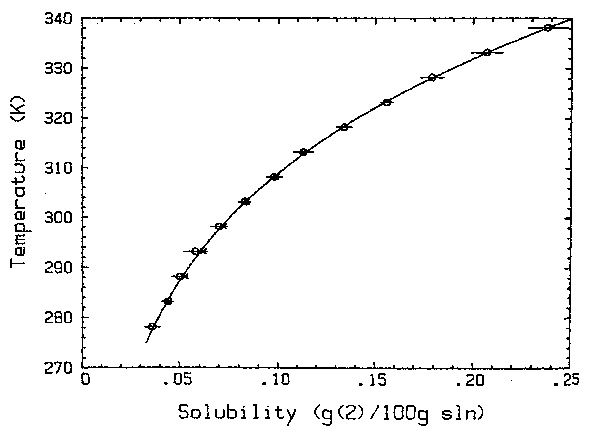
Figure 1 plots the mean solubility values as a function of temperature. Using non-linear regression, these values can be fitted to an equation of the form:

s(g(1)/100g s1n) = 5.5773 - 4.6067 x 10⁻²T + 1.2504 x 10⁻⁴T2 - 1.0489 x 10⁻⁷T3 [1] (Range T: 273-343K, std. error of estimate = 0.0008 g(1)/100g sln., correlation coefficient = 0.9995).
A similar equation was obtained by Arnold et al. (ref 40) from a least squares treatment of their own data:
s(g(1)/100g sln) = 0.1784 - 7.436 x 10⁻⁴t + 1.906 x 10⁻⁵t2 + 1.217 x 10⁻⁷t3 [2] (Range t: 5-70οC, std. dev. 0.0028 g(1)/100g sln).
Solubilities calculated from equation (2) are generally 2% (relative) lower than those obtained from equation (1), i.e. within the limits of precision of Recommended values in Table 2.
Gill et al. (ref 86) present an alternative equation derived from calorimetric studies of the enthalpy and heat capacity of solution of benzene in water between 288 and 303 K.
ln{x1 (T) /x 1 (T+)} = (ΔC∞p,sln/R){ln(T/T+) + (T+/T) - 1} (ΔC∞p,s1n = 225 J K -1 mo1-1, T+ = 289.0 K, ln x1(T+) = -7.843)
where ΔC∞p,s1n is the infinite dilution heat capacity for benzene in water and T+ the temperature of the solubility minimum. Solubilities calculated from this equation are in good agreement (typically lower by 2% relative) with equation [1] over the range 288-303 K. However, they show a systematically increasing deviation at higher temperatures rising to -5.3% at 333 K, i.e. slightly outside the precision limits of the recommended values although well within the 95% confidence interval.
Consistent with these findings, application of the van't Hoff equation to the recommended solubilities (Table 2) gives ΔH∞s1n = 2.07 kJ mo1-1 and ΔC∞p,s1n = 232 J K-1 mo1-1 for the dissolution of benzene in water in good agreement with the experimental values of Gill et al. No evidence was found for any dependence of ΔC∞p,s1n on temperature.
Finally, it is worthwhile noting that Green and Frank (ref 96) have concluded from Henry's law measurements and other thermodynamic data that benzene dissolves in water in monomeric form. These authors also show that solubility determinations based on the measurement of benzene in the vapor-phase by UV spectrophotometry (e.g. ref 73) may be seriously in error.
2. THE SOLUBILITY OF WATER (2) IN BENZENE (1) AT ATMOSPHERIC PRESSURE
Despite the many studies of the solubility of water in benzene the reported values are in only fair agreement. This is probably a reflection of the difficulties of quantitating the relatively low water solubility. Thus, the absolute uncertainty in the averaged solubility of (2) in (1) is virtually independent of the magnitude of the solubility thereby increasing the relative uncertainty at lower solubilities.
The wealth of publications reporting solubility as a function of temperature (ref 2, 5, 6, 13, 19, 32, 56, 61, 81) enables a particularly critical appraisal of all reported solubilities. Hence data which might be acceptable in less well-investigated systems, have been rejected if they deviate significantly from averaged values. This procedure has a small effect on the mean value but often results in a substantial decrease in the uncertainty (σn).
On this basis the data of Clifford (ref 4), Rosenbaum and Walton (ref 11; data below 303 K retained), Tarassenkow and Poloshinzewa (ref 13; data above 283 K retained), Berkengeim (ref 18), Joris et al. (ref 23,24), Wing and Johnston (ref 39), Englin et al. (ref 56; data below 303 K retained), Budantseva et al. (ref 85) and Bittrich (ref 95) have been rejected. Most of these data are lower than the mean values. The approximate values of Griswold et al. (ref 28) and McCants et al. (ref 36) have also been excluded as more precise data are available. All other data are included in Table 3.
It is interesting to note that the average solubilities reported in the more recent studies (ref 58, 59, 61, 64, 68, 76, 78, 81, 87, 94, 102) tend to be somewhat higher than the overall average and with considerably smaller σn (see Table 3). The reasons for these differences are unclear but could be due to improved analytical or purification techniques. If only the more recent data are considered then the averaged values could be "Recommended" between 283 and 298 K. However, comparison of the earlier data (with ref 58 arbitrarily chosen as the cut off) with the more recent values by standard statistical procedures (t-test or F-test) indicates that these two data sets differ significantly (P < 0.05) only at 298 K and possibly 288 K. Further careful measurements are required to resolve this situation.
Figure 2 plots the mean solubility values as a function of temperature. These values can be fitted to an equation of the form:

s(g (2)/100g s1n) = -5.6667 + 6.3535 x 10⁻² T - 2.4024 × 10⁻⁴ T2 + 3.0752 x 10⁻⁷ T3 (Range: T = 273 - 343 K, std. error of estimate = 0.001 g(2)/100g s1n, correlation coefficient = 0.9998).
A similar expression was obtained by Hill (ref 6) by fitting his own data:
s(g(2)/100g s1n) = 0.03294 + 6.449 x 10⁻⁴ t + 3.728 x 10⁻⁵ t2 (Range: t = 5 - 70°C).
Stavely et al. (ref 32) present an alternative equation, in terms of mole fraction, based on their data:
log x2 = 2.237 - (1427/T)
over the range T = 295 - 346 K.
Application of the van't Hoff equation to the mean values in Table 3 gives ΔH∞s1n = 24.0 kJ mo1-1 and ΔC∞p,sln = 89 J K-1 mo1-1 for the dissolution of water in benzene (R2 = 0.9995).
3. THE MUTUAL SOLUBILITIES OF BENZENE (1) AND WATER (2) AT ELEVATED PRESSURES
To clarify the relationship between the phases in equilibrium in this system it is convenient to consider the pressure-temperature projection of the pressure-temperature-composition diagram. On such a projection, phases with the same values of pressure and temperature but different composition will be located at the same point. Benzene + water has type III phase behavior, using Scott and von Konynenburg's classification (ref 105, 106). This type of phase behaviour is characterised by two critical loci, one starting at the critical point of the least volatile component, water in the present case, and eventually approaching high pressures. The other critical locus starts at the critical point of the other component and ends on a three phase (liquid-liquid-vapor) line at a critical end point. Type III phase behavior is illustrated in Figure 3. It is important to note that the three phase line on a pressure-temperature projection corresponds to three lines on the pressure-temperature-composition diagram. In the region above the three phase line on the pressure-temperature-projection, the pressure is greater than the vapor phase and a maximum of two liquid phases is possible. There may be one or two liquid phases depending on the overall composition. To the left of the critical line starting at the least volatile component it is also possible to have one or two phases present depending on the overall composition.
Solubility data for the benzene-water system at elevated pressures have been reported in the publications listed in Table 4.
As Table 4 shows, almost none of the solubility data collected at elevated pressures have been obtained under comparable conditions thus making evaluation of their reliability difficult. Although some of the data are in reasonable agreement (e.g. the value of 22 g(1)/100g s1n at 574.85 K and 14.6 MPa (ref 44) and 22.8 g(1)/100g s1n at 573.15 K and 14.7 MPa (ref 57), most are not. Thus the interpolated solubilities of ref 46 and 55 at 311K and 5 MPa are 0.336 and 0.187 g(1)/100g s1n respectively and other broadly comparable data (e.g. ref 55 and ref 57) are only in fair agreement. It should also be noted that the atmospheric pressure data of Kudchadker and McKetta (ref 46) are in poor agreement with the "Recommended" values in Tables 2 and 3.
Table 5 summarizes solubilities of benzene and water as a function of temperature and pressure. All values were obtained by double graphical interpolation (temperature and pressure) to produce data at convenient intervals. The interested user is referred to the original measurements in the Data Sheets for more comprehensive values. For the reasons given above all the values in Table 3 should be regarded as very tentative, subject to further investigations.
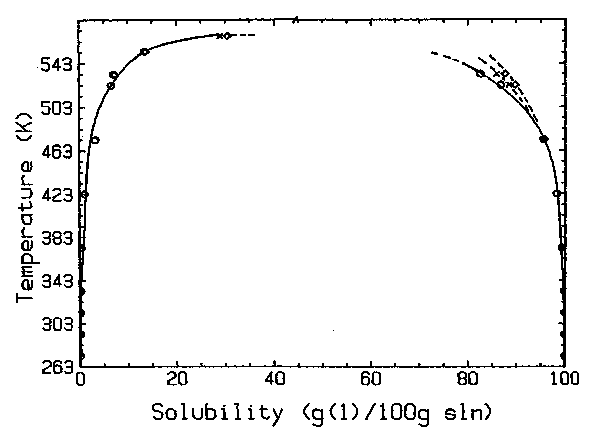
Figure 4 plots the mutual solubilities of benzene and water at elevated temperatures and pressures. The chief effect is to make the solution composition at the (projected) upper critical solution temperature more benzene-rich. This is because the solubility of benzene in water shows a smaller dependence on pressure than the solubility of water in benzene at temperatures near the UCST.
A number of workers (ref 47, 49, 102) have studied the solubility of benzene in water along the three-phase equilibrium locus (Figure 3). The data are summarized graphically in Figure 5 and are seen to be in only fair agreement (note that the solubility is represented logarithmically and that the data from ref 47 is only approximate, see Figure 5 caption). The interested user is referred to the relevant Data Sheets (ref 49,102) for experimental values.
The solubility of water in benzene along the three-phase equilibrium locus has also been reported by three groups (ref 38, 47, 102). The data are summarized graphically in Figure 6 and are seen to be in reasonable agreement. Again it should be noted that the data from ref 47 are approximate only, having been obtained graphically from ref 102. The interested user is referred to the relevant Data Sheets (ref 38, 102) for experimental values.
For the benzene + water system three workers have determined the temperature and pressure of the critical end point and these are given in Table 6. The values are in surprisingly good agreement.
Alwani and Schneider (ref 63) have reported detailed measurements in the high-pressure region to the left of the critical line starting at the critical point of benzene (Figure 3) . These data are for the one phase-two phase boundary and at the pressures and temperatures studied (Table 4), the phases are at liquid-like densities. These data are classified as Tentative as they were determined using as well-tested experimental method.


Figures




Sources:
103
Sanemasa, I.; Arakawa, S.; Araki, M.; Deguchi, T.; Bull. Chem. Soc. Jpn. 1984, 57, 1539-44.
57
Connolly, J. F.; J. Chem. Eng. Data 1966, 11, 13-6.
85
Budantseva, L. S.; Lesteva, T. M.; Nemstov, M. S.; Zh. Fiz. Khim. 1976, 50, 1344.
102
Tsonopoulos, C.; Wilson, G. M.; AIChE J. 1983, 29, 990-9.
101
Sanemasa, I.; Araki, M.; Deguchi, T.; Nagai, H.; Bull. Chem. Soc. Jpn. 1982, 55, 1054-62.
100
Sanemasa, I.; Araki, M.; Deguchi, T.; Nagai, H.; Chem. Lett. 1981, 225-8.
99
Backx, P.; Goldman, S.; J. Phys. Chem. 1981, 85, 2975-9.
86
Gill, S. J.; Nichols, N. F.; Wadso, I. J.; Chem. Thermodyn. 1976, 8, 445-52.
98
Schwarz, F. P.; Anal. Chem. 1980, 52, 10-15.
110
Gorbachev, S. V.; Kondrat'ev, V. P.; Kopylov, V. V.; Tr. Mosk. Khim. - Tekhnol. Inst. 1972, 71, 64-5.
96
Green, W. J.; Frank, H. S.; J. Solution Chem. 1979, 8, 187-96.
95
Bittrich, H.-J.; Gedan, H.; Feix, G.; Z. Phys. Chem. 1979, 260 1009-13.
94
Singh, R. P.; Sah, R.; Indian, J. Chem. 1978, 16A, 692-4.
93
May, W. E.; Wasik, S. P.; Freeman, D. H.; Anal. Chem. 1978, 50, 997-1000
92
Krzyzanowska, T.; Szeliga, J.; Nafta (Katowice) 1978, 12, 413-7.
38
Umano, S.; Hayano, I.; Kogyo Kagaku Zasshi 1957, 60, 1436-7.
90
Korenman, I. M.; Aref'eva, R. P.; Patent USSR, 553 524, 1977.
76
Karlsson, R.; J. Chem. Eng. Data 1973, 18, 290-2.
89
Skripka, V. G.; Tr. Vses. Neftegazov. Nauch. Issled. Inst. 1976, 61, 139-51.
88
Price, L. C.; Am. Assoc. Petrol. Geol. Bull. 1976, 60, 213-44.
87
Kirchnerová, J.; Cave, G. C. B.; Can. J. Chem. 1976, 54(24), 3909-16.
74
Bradley, R. S.; Dew, M. J.; Munro, D. C.; High Temp. High Press. 1973, 5, 169-76.
40
Arnold, D. S.; Plank, C. A.; Erickson, E. E.; Pike, F. P.; J. Chem. Eng. Data 1958, 3, 253-6.
23
Joris, G. G.; Taylor, H. S.; J. Chem. Phys. 1948, 16, 45-51.
24
Black, C.; Joris, G. G.; Taylor, H. S.; J. Chem. Phys. 1948, 16, 537-43.
25
Durand, R.; C. R. Hebd. Seances Acad. Sci. 1948, 226, 409-10.
26
Andrews, L. J.; Keefer, R. M.; J. Am. Chem. Soc. 1949, 71, 3644-77.
27
Booth, H. S.; Everson, H. E.; Ind. Eng. Chem. 1949, 41, 2627-8.
22
Booth, H. S.; Everson, H. E.; Ind. Eng. Chem. 1948, 40, 1491-3.
21
Stearns, R. S.; Oppenheimer, H.; Simon, E.; Harkins, W. D.; J. Chem. Phys. 1947, 15, 496-507.
20
Durand, R.; C. R. Hebd. Seances Acad. Sci. 1946, 223, 898-900.
19
Staveley, L. A. K.; Jeffes, J. H. E.; Moy, J. A. E.; Trans. Faraday Soc. 1943, 39, 5-13.
9
Barbaudy, J.; J. Chim. Phys. 1926, 23, 289-91.
17
Vermillion, H. E.; Ph.D. Dissertation, 1939, Duke University, Durham, NC (USA).
29
Klevens, H. B.; J. Phys. Chem. 1950, 54, 283-98.
16
Saylor, J. H.; Stuckey, J. M.; Gross, P. M.; J. Am. Chem. Soc. 1938, 60, 373-6.
15
Niini, A.; Suomen Kemistilehti A 1938, 11, 19-20.
7
Jaeger, A.; Brennst. Chem. 1923, 4, 259.
1
Herz, W.; Ber. Dtsch. Chem. Ges. 1898, 31, 2669-72.
2
von Groschuff, E.; Z. Elektrochem. 1911, 17, 348-54.
3
Horiba, S.; Mem. Coll. Eng. Kyoto Imp. Univ. 1914, 1, 49.
4
Clifford, C. W.; Ind. Eng. Chem. 1921, 13, 631-32.
5
Hill, A. E.; J. Am. Chem. Soc. 1922, 44, 1163-93.
6
Hill, A. E.; J. Am. Chem. Soc. 1923, 45, 1143-55
14
Robertson, J. B.; South Afr. J. Sci. 1933, 30, 187-95.
8
Milligan, L. H.; J. Phys. Chem. 1924, 28, 494-7.
10
Uspenskii, S. P.; Neft. Khoz. 1929, 11-12, 713-7.
11
Rosenbaum, C. K.; Walton, J. H.; J. Am. Chem. Soc. 1930, 52, 3568-73.
12
Gross, P. M.; Saylor, J. H.; J. Am. Chem. Soc. 1931, 53, 1744-51.
13
Tarassenkow, D. N.; Poloshinzewa, E. N.; Ber. Dtsch. Chem. Ges. 1932, 65B, 184-6.
28
Griswold, J.; Chew, J. N.; Klecka, M. E.; Ind. Eng. Chem. 1950, 42, 1246-51.
45
Caddock, B. D.; Davies, P. L.; J. Inst. Petrol. 1960, 46, 391-6.
56
Englin, B. A.; Plate, A. F.; Tugolukov, V. M. Pryanishnikova, M. A.; Chem. Technol. Fuels Oils, 1965, 1(9), 722-726.
55
Thompson, W. H.; Snyder, J. R.; J. Chem. Eng. Data 1964, 9, 516-20.
54
Hogfeldt, E.; Bolander, B.; Ark. Kemi 1963, 21(16), 161-86.
53
Udovenko, V. V.; Aleksandrova, L. P.; Zh. Fiz. Khim. 1963, 37, 52-6.
52
Schatzberg, P.; J. Phys. Chem. 1963, 67, 776-9.
51
McAuliffe, C.; Nature 1963, 200, 1092-3.
50
Jones, J. R.; Monk, C. B.; J. Chem. Soc. 1963, 2633-5.
49
Guseva, A. N.; Parnov, E. I.; Vestn. Mosk. Univ. Khim. 1963, 18, 76-9.
48
Franks, F.; Gent, M.; Johnson, H. H.; J. Chem. Soc. 1963, 2716-23.
47
Thompson, W. H.; M.S. Thesis, 1962, Pennaylvannia State University (USA);
46
Kudchadker, A. P.; McKetta, J. J.; Petrol Refiner 1962, 41, 191-2.
30
Bohon, R. L.; Claussen, W. F.; J. Am. Chem. Soc. 1951, 73, 1571-8.
44
Rebert, C. J.; Kay, W. B.; AIChE J. 1959, 5, 285-9.
58
Johnson, J. R.; Christian, S. D.; Affsprung, H. E.; J. Chem. Soc. A. 1966, 77-8.
42
Pavia, R. A.; "The Solubility of Water in Benzene", M.S. Thesis, 1958, North Carolina State College, Raleigh, NC.
41
Brady, A. P.; Huff, H.; J. Phys. Chem. 1958, 62, 644-9.
43
Alexander, D. W.; J. Phys. Chem. 1959, 63, 1021-2.
39
Wing, J.; Johnston, W. H.; J. Am. Chem. Soc. 1957, 79(4), 864-5.
18
Berkengeim, T. I.; Zavod. Lab. 1941, 10, 592-4.
37
Hayashi, M.; Sasaki, T.; Bull. Chem. Soc. Japan 1956, 29, 857-9.
36
McCants, J. F.; Jones, J. H.; Hopson, W. H.; Ind. Eng. Chem. 1953, 45, 454-6.
35
Morrison, T. J.; Billett, F.; J. Chem. Soc. 1952, 3819-3822.
34
McDevit, W. F.; Long, F. A.; J. Am. Chem. Soc. 1952, 74, 1773-7.
33
Donahue, D. J.; Bartell, F. E.; J. Phys. Chem. 1952, 56, 480-4.
32
Staveley, L. A. K.; Johns, R. G. S.; Moore, B. C.; J. Chem. Soc. 1951, 2516-23.
31
McBain, J. W.; Lissant, K. J.; J. Phys. Colloid. Chem. 1951, 55, 655-62.
84
Sada, E.; Kito, S.; Ito, Y.; J. Chem. Eng. Data 1975, 20, 373-5.
83
Mackay, D.; Shiu, W. Y.; Can. J. Chem. Eng. 1975, 53, 239-42.
82
Krasnoschchekova, R. Ya.; Gubergrits, M. Ya.; Vodnye. Resursy. 1975, 2, 170-3.
81
Goldman, S.; Can. J. Chem. 1974, 52, 1668-80.
80
Brown, R. L.; Wasik, S. P.; J. Res. Natl. Bur. Stan. 1974, 78A, 453-60.
79
Sultanov, R. G.; Skripka, V. G.; Zh. Fiz. Khim. 1973, 47, 1035.
78
Polak, J.; Lu, B. C. Y.; Can. J. Chem. 1973, 51, 4018-23.
77
Leinonen, P. J.; Mackay, D.; Can. J. Chem. Eng. 1973, 51, 230-3.
91
Korenman, I. M.; Aref'eva, R. P.; Zh. Prikl. Khim. 1978, 51, 957-8.
75
Filyas, Yu.; I. Sb. Nauch. Tr. Vses. Neftegazov. Nauch. -Issled. Inst. 1973, 45, 68-70.
73
Ben-Naim, A.; Wilf, J.; Yaacobi, M.; J. Phys. Chem. 1973, 77, 95-102.
59
Masterton, W. L.; Gendrano, M. C.; J. Phys. Chem. 1966, 70, 2895-8.
72
Pierotti, R. A.; Liabastre, A. A.; "Structure and properties of water solutions. " U. S. Nat. Tech. Inform. Serv.; PB Rep.; 1972, No. 21163, 113 p.
70
Roof, J. G.; J. Chem. Eng. Data 1970, 15, 301-3.
69
Bröllos, K.; Peter, K.; Schneider, G. M.; Ber. Bunsenges. Phys. Chem. 1970, 74, 682-6.
68
Roddy, J. W.; Coleman, C. F.; Talanta 1968, 15, 1281-6.
67
Burd Jr., S. D.; Braun, W. G.; Proc. Div. Refining.; Am. Petrol. Inst. 1968, 48, 464-76.
66
Worley, J. D.; Can. J. Chem. 1967, 45, 2465-7.
65
O'Grady, T. M.; J. Chem. Eng. Data 1967, 12, 9-12.
64
Gregory, M. D.; Christian, S. D.; Affsprung, H. E.; J. Phys. Chem. 1967, 71, 2283-9.
63
Alwani, Z.; Schneider, G. M.; Ber. Bunsenges. Phys. Chem. 1967, 71, 633-8.
62
Taha, A. A.; Grigsby, R. D.; Johnson, J. R.; Christian, S. D.; Affsprung, H. E.; J. Chem. Educ. 1966, 43, 432-5.
61
Moule, D. C.; Thurston, W. M.; Can. J. Chem. 1966, 44, 1361-7.
60
McAuliffe, C.; J. Phys. Chem. 1966, 70, 1267-1275.
71
Corby, T. C.; Elworthy, P. H.; J. Pharm. Pharmacol. 1971, 23 suppl. 39 S-48 S.
97
Banerjee, S.; Yalkowsky, S. H.; Valvani, S. C.; Environ. Sci. Technol. 1980, 14, 1227-9.
109
Gorbachev, S. V.; Kondrat'ev, V. P.; Belousov, A. I.; Kopylov, V. V.; Tr. Mosk. Khim. - Tekhnol. Inst. 1972, 71, 62-3.
108
Scheffer, F. E. C.; Proc. Roy. Acad. Amsterdam 1913, 16, 404-18.
107
Herz, W.; Boll. Chim. Pharm. 1915, 54, 37.
106
Hicks, C. P.; Young, C. L.; Chem. Rev. 1975, 75, 119.
105
van Konynenburg, P. H.; Scott, R. L.; Phil. Trans. Roy. Soc. A
1980, 298, 495.
104
Alwani, Z.; Schneider, G. M.; Ber. Bunsenges. Phys. Chem. 1969, 73, 294-301.