
Evaluator
A. Vesala Department of Chemistry and Biochemistry, University of TurkuEvaluation
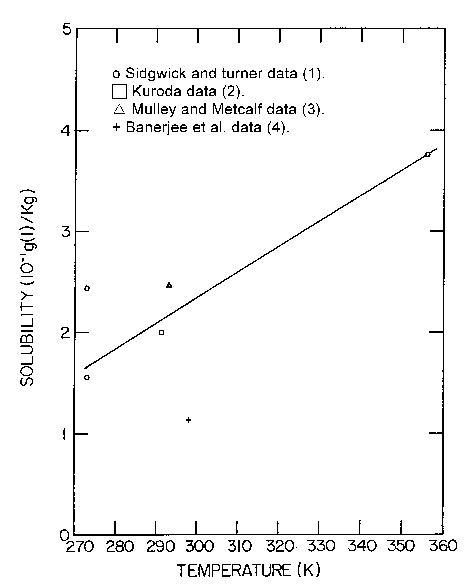
Kuroda (2) found the solubility of 2-chlorophenol in water to be in the order of 2 percent at room temperature (291 K). Better agreement is obtained when the data of Mulley and Metcalf (3) are compared with the values of Sidgwick and Turner. The 24.65 g (l)/dm3 value of Mulley and Metcalf corresponds to a value of 25 g (l)/kg (assuming a density of 1.0 g/cm3 for the solution).
The more recent work of Banerjee et al. (4) gives a value of 88.3 mmol (l)/dm3 corresponding to approximately 11 g (l)/kg, a value that does not agree well with the earlier values. One possible reason for this lack of agreement may be associated with the use of a radiochemical method of analysis by Banerjee et al. For instance, a systematic error could have resulted from radiochemical impurities of the substrate. In any event, the lack of relevant information makes an evaluation here too speculative. The available experimental data are shown in Figure 1.

It should be mentioned that the pH of the solutions exerts a considerable influence on the solubility values of those solutes such as 2-chlorophenol capable of protolytic action. Here it is assumed that the reported solubilities refer to the pH values which prevail in the saturated solutions of 2-chlorophenol in water.
No more than a tentative value can be assigned to the solubility of 2-chlorophenol in water. The following value has been obtained from the data shown in Figure 1 by a graphical interpolation:
None
| C $T$ ($\pu{K}$) | D $x_{1}$ | D MR1 (g/kg) | D $C_{1}$ (mol/dm3) |
|---|---|---|---|
| 298.15 | 2.9 x 10⁻³ | 20.0 | 1.6 x 10⁻¹ |
Figure
Sources:
1
Sidgwick, N. V.; Turner, S. L.; J. Chem. Soc. 1922, 121, Part II, 2256-63.
2
Kuroda, T.; cf. Chem. Zentralbl. 1926, I, 3610.
3
Mulley, B. A.; Metcalf, A. D.; Sci. Pharm. 1966, 2, 481-8.
4
Banerjee, S.; Yalkowsky, S. H.; Valvani, S. C.; Environ. Sci. Technol. 1980, 14, 1227-9.